Tuesday, December 7, 2010

Interiors

Place Bourbon, 2006

Regular readers know that one of my favorite photographic motifs is the “portal perspective,” pictures taken looking out a window or doorway. But I hadn’t realized until I looked back through some pictures from a recent trip to Providence, Rhode Island, that I seem to be pretty shameless about taking pictures that look in, as well.

I’m not so much of a voyeur that I would think to photograph people in their privacy of their own homes. But when I am somewhere where interiors are visible from the street without any mechanical amplification or violation of privacy, I do like to imagine stories that take place in the rooms I see.

I can easily envision stories in each of these:

Red & Blue Rooms, 2010

Window Lace, 2010

Keeping Watch, 2010

Ceiling Shadows, 2010

Seeing these reminded me of Place Bourbon, above, which is just down the street from the hotel where my wife and I stayed during our last trip to Paris. It’s kind of a swank neighborhood with a surprisingly affordable little hotel in the middle of it. A lot of the apartments were dark during the time we were there. (Do Parisians all leave town in late May?) But every now and then you’d look up and catch a scene like this and wonder what lush life might be lived there.


Monday, December 6, 2010

When the Place Turns Out to Be Unimportant

What Just Happened, 2003

I’ve been photographing the town of Edenton, North Carolina, off and on for eight or nine years. When she was young my mother had relatives there. Antique dealers, it was said, who would gratefully sell you anything out of their home for a price. (She came home with a set of dining room chairs.)

I wasn’t introduced to Edenton formally until friends of ours from Richmond renovated a historic home in Edenton in the late 1990s and invited us to visit. We spent many sunny afternoons talking, laughing, eating and drinking in that old house.

Sadly, that couple is no longer together. But my wife and I were so hooked on Edenton that when retired relatives of hers were looking for a place to settle in the Mid-Atlantic region, Edenton was one of the places we took them to visit. They ended up staying, so we now visit Edenton regularly.

What distinguishes Edenton from a lot of other Southern towns is its exceptional collection of original Colonial and Revolutionary War-era residences. That they are still standing is said to be the result of the ladies of Edenton having made an accommodation of some kind with General Sherman, who in return agreed not to burn down Edenton while cutting his destructive swath through the South during the Civil War.

The Chowan County Courthouse in Edenton, North Carolina is one of the showcase structures of Edenton. Built in 1767, the Courthouse is said to be the nation's most well preserved Colonial courtroom and certainly one of the finest Georgian courthouses in the South.

When I first visited Edenton, carpenters and masons were swarming over the Courthouse, shoring up its foundation, pointing and restoring its external brick walls and refinishing the floors and paneling of the rooms inside. The Courthouse was in regular use until 1999, at which time it was closed. Renovation and restoration of its original floor plan began after several years of fund raising. Today the building is partially restored to its 18th Century configuration.

The usual picture one sees of the Chowan County Courthouse looks like this:

Or this one:

They might be useful pictures if you’ve never seen the Courthouse before. But like so many pictures of many historic places, they don’t have a lot of apparent story to them. It doesn’t take much time for you to see them and be ready to move on.

My first twist on the normal short of the Chowan County Courthouse was this:


It’s still a pretty straightforward shot. But at least playing with the light gave it a little more hint of story.

My favorite photograph of the Chowan County Courthouse turns out to be What Just Happened, above, ironically the least place-specific of all of the pictures I’ve taken there. It was taken during a Christmas tour and shows a woman, actually my wife’s aunt, stepping out the front door of the courthouse. I like to think there’s more story to What Just Happened, as I described here.

I suppose the lesson here, if there is one, is that the picture you bring home because you like it the most is not always the one you set out to take or even one that is recognizable as being from that place.

Friday, December 3, 2010

Taking Work from Professionals

Free Your Speech, 2010

Every now and then I get a call from someone asking if I’ll do a commercial photo shoot. It might be something with a model, or a product shot or some kind of event. Even weddings. It’s flattering to get these calls. If I were making my living from photography these calls would be my lifeline.

But I never accept these assignments. Don’t get me wrong. I’m flattered that some people think I might be up to that kind of work. But the truth is, my heart’s not in it. More importantly, there are people who are very good at these kinds of jobs and who need this work to make a living. Some of these people are my friends. I know how hard they’ve worked to build their businesses. It would bother me to know that I was taking work from them.

I’m sure somebody will say I’m “leaving money on the table,” or being foolish about my own financial future. Both are probably true. But I’ll bet I sleep better than they do.

Professional photographers have had a hard enough time in recent years without all of the rest of us—anyone with the capacity to buy a decent camera—taking their work away. A lot of clients can’t tell the difference between a good photograph and a bad one. Some don’t care. One of the professional marketing journals I receive is mindless, not to mention visually boring, in the way it uses the same four or five stock photos in every issue.

I’m told that big time photography clients are paying less than they used to and asking for more from the photographers they work with. Contract photojournalists often don’t get anything more when the pictures they took for one publication get used online or in sister publications. Some clients are asking for more speculative work, or asking for extra work for free and promising to “make it up on the next job.”

There’s nothing illegal about all this. Some of it’s just the nature of competition, the evolution of the world of commercial photography and the constant balance between supply and demand. But I have a hard time aiding it. I figure life’s too short to spend it screwing up other people’s livelihoods. I’m happy to lend a photo for free to a nonprofit. But if I’m lending a photo or selling a photo for a commercial assignment that I know would have otherwise been done by a working professional, I charge what I think the professional would have charged. That I’m fortunate enough to not have to depend on that income does not make it okay for me to lower the integrity and perceived value of all of our work.

Not everyone may agree with me, I expect. I’m a big believer in the Golden Rule. I’ve been the recipient of enough goodwill in my lifetime to know that what goes around does come around, and that you get as you give, whether in your personal life, your professional life or in your art.

Thursday, December 2, 2010

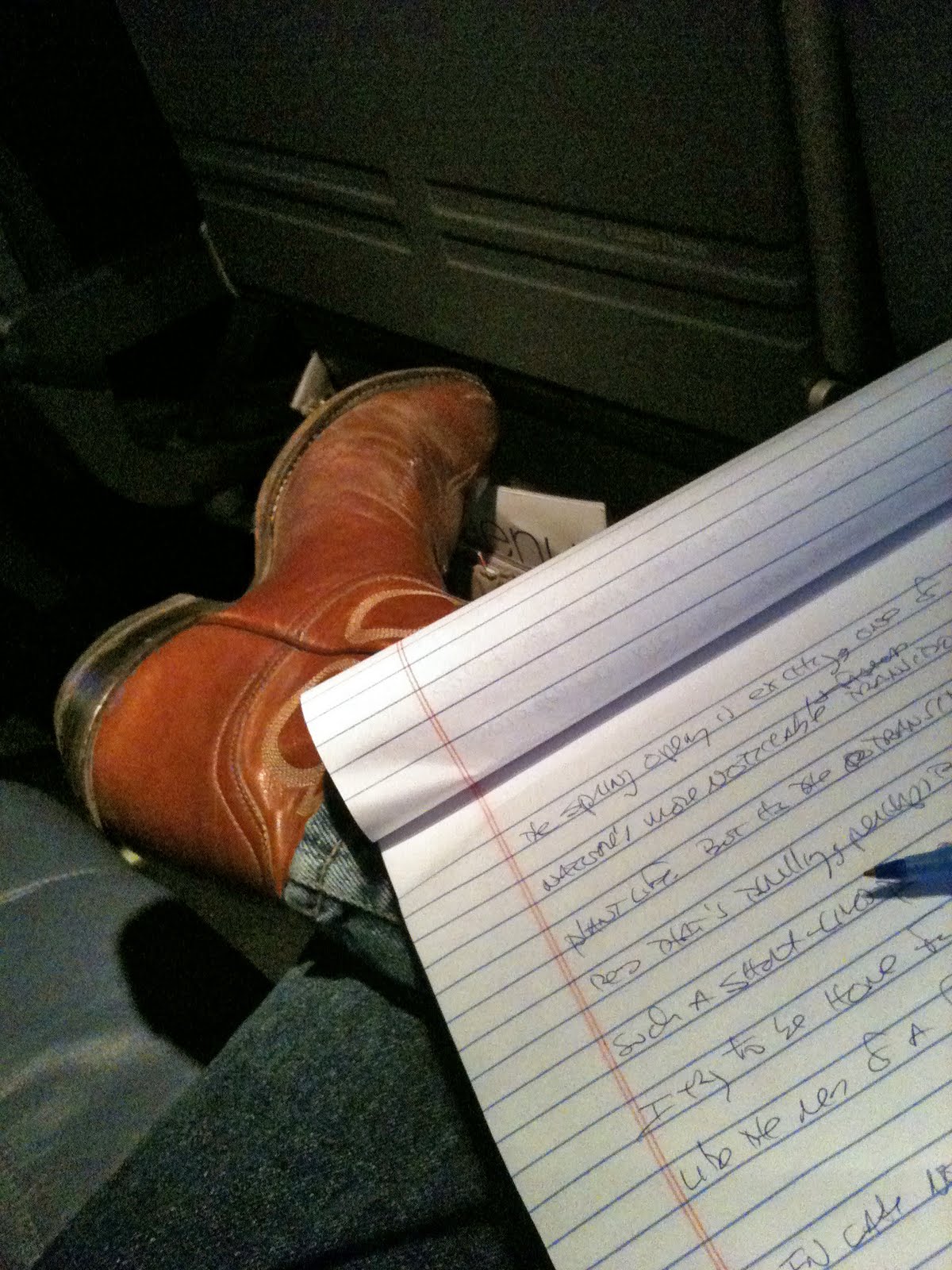
Overheard: Flight 2901 from Norfolk to Houston

Plane Work, 2010

(The people seated around me included a group of teenage boys on their way to Mexico for a church mission trip.)

“When we get to Houston we’ve got a three-hour layover, then a two-hour flight and then a four-hour drive. Rest up, boys!”

“Will the church be ready when we get there?”

“I’m hungry. Don’t they have any food on this plane?”

“Do you know Wallace? Momma says he’s the best pastor ever.”

“Are we ever going to land, or what?”

“How do I look?”

“When we were little you used to just look at yourself in the mirror and pop your knuckles.”

“I got to spend a day with my husband. He just got home from a year in Afghanistan. I couldn’t stay longer because I’m studying to be a hairdresser in Arkansas. You know, you can’t miss a day when you’re doing that or you might miss something important.”

“I think you ought to stuff that deer and put it in your den. I can’t believe you don’t display the deer you’ve shot.”

“They can’t make me wear a seat belt. [Pause] Can they?”

“I don’t have much vacation time. I have tons of doctors’ appointments. I have a lot of problems.”

“Do we have time to shop? Oh, I hope we have time to shop.”

“Are the people where we’re going white?”

“Do the have Wal-Marts in Texas?”

“Why are the pieces of the wing coming apart?”

“Why’d you buy such cheap tickets?”

“We didn’t see no dead people.”


[It occurred to me as I transcribed these scribbled notes from the back of a boarding pass that someone might think my “Overheard” posts are the result of determined eavesdropping on my part. Nothing could be farther from the truth. The reason I’m usually provoked to capture these comments is because they were spoken so loudly that they interrupted whatever it was I was doing by people who seemed to believe they were either in a cone of silence or so important that everything they said should be required listening for everyone within thirty feet.]


Wednesday, December 1, 2010

The Story in the Window

The Story in the Window, 2010

Start with a picture and eighteen random words:

Respect. Mother. Naughty. Owe. Acting. Boot. Muck. Breathe. Little. Flagged. Revised. Enlightenment. Universe. List. Deaf. Crying. Henry. Vision.

The story:

Skye didn’t recover easily from her fights with Parker. He could go off to class in the morning as if nothing had happened over breakfast and she’d still be sitting at the table crying two hours later. She moved the plant from the table over to the windowsill to get some sun. She turned the chair around and sat watching cars come and go in the street by their building. Every hour, like clockwork, the meter maid put-putted up the street in her little three-wheeled scooter, checking the tires of the cars she’d flagged with chalk an hour before to see if they’d overstayed their time. One of the cars due to get a ticket belonged to the guy across the street who had so many girls up to his place that Skye’s friends had taken to calling him Naughty Nick. He came out and sweet-talked the meter maid into giving him an extra hour.

Skye called her friend Rebecca. “He’s driving me nuts. Should I stay with him? Am I acting like a baby to get so upset?”

“Make a list,” Rebecca answered dryly. “If the pluses outnumber the minuses, think about it. If not, give him the boot. You don’t owe him anything.” She paused to give Skye a chance to respond. When Skye didn't, Rebecca asked, “Do you love him?”

“I don’t know. Some days I feel like he’s the air I breathe. Other days I just want to shoot his ass.”

She made a list, even though it seemed like the kind of methodical thing her mother would have suggested. The thought of her mother only made things worse. Her mother already thought Parker didn’t respect her. “Anybody can see he thinks the universe revolves around him,” she’d said the last time she visited. “He’s deaf to anything of importance to you.”

The list was inconclusive. As many likes as dislikes. Skye decided to distract herself by doing some laundry before going to class. When she came back upstairs from the basement, she revised the list. In the light of the new list Parker didn’t look as good.

Rebecca’s right, Skye thought. I don’t owe him anything. Every idea I have he seems determined to muck up. She washed her face, brushed her hair, cleared her vision and headed off to class to spend two and a half hours parsing the meaning of rationality in Professor Henry Wicksack’s class on the Age of Enlightenment.

Tuesday, November 30, 2010

Sixty-Three Fragile Moments

Each One a Gift, 2010

Yesterday morning, as part of a project I’m working on, I visited the neonatal intensive care units at our local children’s hospital.

Spread across a half dozen or so separate and carefully isolated areas, sixty-three tiny babies are struggling to survive. Sometimes the hospital has to find room for more. Most were born prematurely. They’re placed in high tech cribs, many covered by home made quilts that minimize stimulation. The lights are kept low here. Monitors and lines and machines that hiss and hum and beep are everywhere. The average stay is thirty days. A few of these infants won’t make it. Twins are apparently especially vulnerable. Nurses or doctors are never more than a few steps away.

Parents from all walks of life are one when it comes to being here, there being little more than a chair and a curtain, and sometimes not even that, separating one crib from the next. But parents seem to like having each other close by to share moments of progress and to have someone to lean on in moments of crisis.

Sixty-three fragile infants. Each breath a gift. I tell you, there’s nothing like a visit to a place like this to remind you just how inconsequential any problems you think you might have really are.

On my way out, I heard a loud cry from one of the tiny infants, a child barely bigger than my hand. The nurses all turned around and smiled. One exclaimed, “That’s the kind of lungs we like to hear around here!”


Monday, November 29, 2010

The Dog Ate My Picture

Vineyard Haven Dawn, 2010

(Double click to see Larger)

Our friend Brenda told us about how last Wednesday she made a lemon meringue pie to take to a friend’s house for Thanksgiving. Only while she and her husband were tending to other things their dog used its paws to stand up at the end of the dining room table and eat half of the pie.

Brenda had time to make another pie later that afternoon. The friends who were hosting the Thanksgiving dinner are big fans her Brenda’s pies and she was determined to thank them by bringing them one of their favorites.

Only while that pie was setting up, this time up on the kitchen counter, Brenda’s husband had to go to the doctor’s office unexpectedly and they didn’t get back home until late, whereupon they discovered that the dog had managed to reach up and eat half of the second pie.

(Like Brenda’s husband, my first instinct at a time like that would have been to cobble the two untouched halves together and cover them with some fresh meringue. But Brenda’s a stickler about food safety. So enough said about that good idea.)

On Thanksgiving morning Brenda got up early and made yet another pie. This one she guarded personally until it was time to go to the friend’s house.

I don’t think it’s stretching things too far to say that making pictures can sometimes be like this. It used to be you could take a terrific picture and then have it destroyed if you didn’t develop the film properly or if two pieces of negative touched each other during processing. That’s what happened to this picture, a once-in-a-lifetime photographic opportunity ruined.

SS United States, 1989

I sent the film out for processing and it came back with emulsion all over it. All I could do, years later with the assistance of Photoshop, was clean up the emulsion spots and blur the image into a work of Impressionism.

These days it’s most a matter of taking your picture and then discovering something wrong with it when you get it up on the screen. It could be a bad exposure or an item that intrudes in the scene that you didn’t notice when you were taking the picture.

Most times I have only myself to blame for the faults. Like in the case of Vineyard Haven Dawn, above. I knew the light wasn’t right when I took the picture. But I think I could have ended up with something much better if I’d been more mindful of exposing for the rising sun, which in the absence of having done such is just a big blown out blot on this picture.

But next time this happens I think I might blame it on the dog. There were dogs on the ferry where I was standing when I took this picture. If Brenda’s experience is any indication, that ought to be good cover for a couple of bad shots.