

Samitaur 78, 2011
[Part 1, in case you missed it.]
What drew me initially to visit the Hayden Tract—where the work of developers Frederick and Laurie Samitaur-Smith and architect Eric Owen Moss is now known collectively as Conjunctive Points—is the way Moss and the Smiths have woven a series of unusual structures together to form a veritable creative class campus. If you've visited The Presidio in San Francisco in recent years, you've seen a similar mix of creative class tenants and applications. But the Presidio re-development was held to rigid historic preservation standards and therefore has little of the design energy and artistic serendipity of Conjunctive Points.
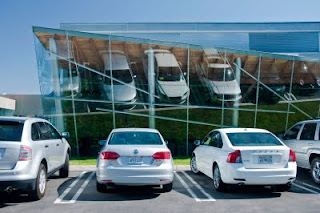
At first glance, you're drawn to the unusual exterior appearance of the buildings, which are identified by such names as Stealth, Slash, Backslash, Samitaur and Umbrella. Walls lean in and out. Steel beams and timber arcs poke out like unfinished conversations. Laminated glass panels that look like they’ve been forged from magma stand out from the corner of one building. The Samitaur “Stealth” building that faces Hayden Avenue looks like the underside of the Millennium Falcon space ship from Star Wars. Exterior gathering spaces that would seem completely cold and antisocial at first glance aren’t.


The buildings at Conjunctive Points do not form a cohesive campus or relate to each other in any other respect than that they are all contained within a single security perimeter and each is highly unusual in its appearance. They’re like a collection of whimsical toys. A tower built from steel beams salvaged from one of the old factories and serving no immediately visible practical purpose sits at the corner of Hayden Avenue and National Boulevard. It’s not only an iconic first impression of what lies behind it, but also the focal point for the Jubilee light rail line just across the street that will soon connect Culver City and the Hayden Tract with downtown Los Angeles and beyond.
It’s the exteriors that first catch your eye. But upon closer examination--and this is what elicited my double take--you notice what a special and unusual mix of creative class businesses have chosen to make Conjunctive Points their home. Befitting the metropolitan area that likes to call itself the "creative capitol" of America, many of the businesses in Conjunctive Points serve the entertainment industry, whether in animation, special effects, music, talent management, production and marketing. But there is also WPP/Ogilvy, one of the world's leading ad agencies, a leading video game maker and just across the street are Nike and the headquarters for several cable channels.
The more you attune your eye to the surroundings, the more you realize how just about everyone who works here is young, talented, determined and engaged in creating something original. People work furiously in their own private spaces and in groups. Voices in conference rooms rise and fall. The businesses in Conjunctive Points are all internationally known; many chose this to be their first home. The decals on the cars in the parking lot reflect education at the nation’s best schools. You see employees from different businesses taking a break outside talking trade.
That’s when it struck me that what’s appealing about this place is that it’s open and opportunistic in a way that most developers of commercial buildings built on spec would find too edgy. But that’s not the Smiths. It’s no coincidence that the motto of their company “From the Verge…to the Edge.”
What makes Conjunctive Points uncomfortable to many older persons is precisely what makes it appealing to the youthful creative class. As I walked around Conjunctive Points, I kept asking myself, “How does a place like this come to exist?” The first instinct is to say that it probably couldn’t happen where I live because the big builders in my area have tended to be big institutions—government agencies, banks and universities—that don’t do “edgy.”
The transition of the abandoned industrial Hayden Tract into the stylish Conjunctive Points with its newfangled buildings and teeming “bright young things” workforce happened precisely there was so little institutional intervention. Nobody cared about the Hayden Tract. What happened here happened only because of the Smiths and their innovative architect and his partners worked against all the odds to make it happen.
It took every bit of creative financing the savvy Smiths could come up with to get the Hayden Tract off the ground. I don’t know if they even intended to make something that would be appealing to what we today refer to as the “creative class.” But what they have done is incredibly impressive and arguably the best example of building to the needs of the creative class that I've ever seen.
One of the things that makes Conjunctive Points so impressive is how it has both respected and cast off its Industrial Age motif and, in doing so, created something that is both artistically engaging and conducive to the kind of creative diversity and cross-pollination that attracts talent and creates innovative enterprises.
Oh, and lest you think that the Smiths were just design dilettantes, I should mention that today they own more than a million square feet of space in the Hayden Tract and that the value of that property has increased by 500% since 1992.
As my friend Patrick Masterson reminded me recently, “design matters.” And it can make money and draw the creative class.




 Posts
Posts

