Friday, August 12, 2011

Funky, Funky Venice

Venice 220, 2011

There are at least two places in America that call themselves Venice and probably countless neighborhoods in other cities that call themselves “little Venice.” I think it’s safe to speculate that all of them were the creations of real estate developers anxious to turn some kind of low, marginal land into desirable residential property. Having been developed to maximize the number of building sites, though, none of these ersatz Venices have the serendipity and narrow serpentine canals of Italy's Venice. Instead, where there are canals—Florida’s Venice doesn’t even have the canals—they are of uniform width and neatly lined up parallel to one another.

Florida's full of communities built along canals carved out of muddy swamps. Most were developed to appeal to "snowbirds" and, as such have the neat and tidy look of places where old men wear white shoes, play shuffleboard and reminisce about their old winter heating bills back in Minnesota.

California's Venice is like the other American Venices in that it was created by a land speculator, in this case a man named Abbot Kinney who built a giant amusement park and pier for the sweaty masses from nearby Los Angeles and later carved out a vast network of canals. But compared to Florida's neat and tidy Venice-as-snowbird-haven, California's Venice is decidedly shabby chic. Parts of it are downright shabby, others just comfortably casual enough for it to be clear that it takes millions of dollars to live there.

Venice, California, isn't just canals, though. (Besides, many of Kinney’s original canals were eventually filled in and turned into roads.) Venetians like to brag that they’re second only to the Mission District of San Francisco on the funkiness scale. Venice has a beautiful wide beach and oceanfront promenade that's home to all kinds of flaky businesses, buskers, body builders and vendors. Looking for a doctor who’ll certify you for medical marijuana? There's one in just about every block. Looking for psychic crystals, magic beads and throat whistles? Check, check and check. How about a freak show with a lady with three heads or buskers channeling everything from Peruvian pan flutes to old Doors songs and Hendrix riffs? Yep, all of those and more.

Venice Homage to Starry Night, 2011

Pretty Women ATM, 2011

I’ve never been to Venice Beach when the promenade wasn’t crowded with people. Last Thursday was no exception. Thousands of people strolled, biked and rollerbladed along the concrete strand. The streets, alleys and parking lots were further congested by a fleet of Warner Brothers trucks and craft vehicles on location filming an episode of "Gossip Girls." At one point a cute young girl wearing little more than a bathrobe brushed past me. Nothing about her and her scanty clothing seemed out of place in Venice. Only because hundreds of people lifted their cell phones to snap pictures of her gave me reason to ask someone who she was? (A starlet by the name of Blake Lively, it turns out.)

Freak Show Teases, 2011

Taking In Venice, 2011

When the crowds got to be too much for me, I wandered a few blocks over to the much quieter residential neighborhood where the canals are. As the sun began to set, neighborhood residents sat enjoying drinks and conversation in their yards overlooking the canals. Some visited with neighbors along the narrow walkways that line the canals. Once upon a time this area was a hangout for bohemian dropouts. Today it’s said to be one of Los Angeles’ most expensive neighborhoods. It costs nothing to walk in Venice, however, which made this a wonderful place to end the day before I had to go to the airport for an overnight flight back east and home.

Venice 220, 2011

Thursday, August 11, 2011

Malibu Barbie

Malibu Pier 6, 2011

It wasn’t until some years ago when I first visited Palo Alto, California, in September that I realized just how dry it gets out there in the fall. Seeing all that brittle brown vegetation made it much easier for an Easterner to understand why wildfires are so easy to start and spread out there.

Malibu’s like that, too. Like me, you might have wondered how people living practically on top of the Pacific Ocean could have such problems with wildfires. But now that I’ve driven the short distance up the coast to Malibu from Santa Monica I can understand how four asphalt lanes of Pacific Coast Highway are scant protection from wildfires that ignite somewhere up in the Santa Monica Mountains and spread rapidly down to the shore.

But thoughts of that unpleasantness passed quickly last week when I had a chance to drive up to Malibu for lunch. It was sunny. The temperature was in the low 80s. The humidity was low. In short, conditions were just about heavenly.

Malibu Pier 19, 2011

I didn’t really have much interest in visiting the commercial center of Malibu. But I did find the Malibu Pier to be an appealing photographic subject. I thought I’d have lunch at the restaurant that’s out on the pier, but the lines waiting to get in snaked out to the highway. So I settled for the diner/beer joint just across the highway, where I could have sworn I heard one of the waitresses being called Barbie. If I’m wrong on that count, let’s just say it’s the kind of place where waitresses could be called Barbie.

The Malibu Pier was built in 1905 by a local rancher as a transfer point for his cattle and crops to get to waiting ships. Over the years ownership of the pier passed back and forth between private and public hands. After falling into disrepair following a battering by El Nino storms, the pier was closed during the 1990s. It later reverted to state ownership and is today operated by the California State Parks system.

Malibu Pier 27, 2011

It’s a gorgeous old pier. The railings and structures are painted bright white with bright blue trim. (This must be an official California color scheme, as it’s the same colors used on the Crystal Pier I visited down near La Jolla last December.) You can look down between the floorboards and see the ocean rolling underneath you just about anywhere you are on it. On a bright day, this color scheme, combined with a blue sky and green ocean, made for a terrific subject. I spent about twenty minutes on the pier, poking around, walking up and down steps and generally casing the joint. Barbie was still watching over my car when I got back to it.

Malibu Pier 28, 2011

Malibu Pier 36, 2011

Wednesday, August 10, 2011

Under the Umbrella

The Umbrella 58, 2011

I think most people might agree that the most unusual and unexpected building at Conjunctive Points is the building known as the Umbrella.

Back when the Frank Gehry-designed Disney Concert Hall in downtown Los Angeles didn’t look like it would ever be built, the developers and architect of Conjunctive Points hoped that the Umbrella would become the home of the Los Angeles Philharmonic’s “Green Umbrella” experimental music series. This would have fulfilled their goal of making Conjunctive Points not only a viable commercial space, but also a cultural arts destination.

The Umbrella’s a complex place, design-wise. Only someone with a highly sophisticated three-dimensional design sense could have conceived of it, given how it looks like it was designed with a zero gravity environment in mind. The interior was designed to be an almost completely open space in which a variety of moveable stages and seating areas could be custom arranged depending on the program and audience size.

The Umbrella 67, 2011

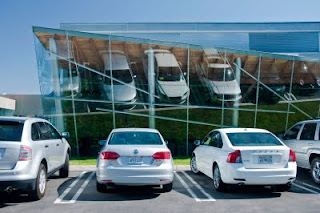
The real treat, however, was the exterior performance space, the part shown in the picture above. It looks like a giant fly or grasshopper embedded into a corner of the building. The concept was for the audience to be seated on a series of flexible platforms below and on the lawn while the part that looks like the big fly hanging off the edge of the building is actually a balcony/stage designed to hold the performers and protect them from the elements. The balcony’s canopy consists of a series of undulating laminated glass panels that look like they were shaped by a volcano or worn by the sea like pieces of seashell.

Fortunately, or unfortunately, depending in your perspective, Disney Hall was eventually built and the Green Umbrella series is housed there. The exterior balcony stage of the Umbrella building has been used as a performance space for charitable events, but has no resident company. The interior was completely reconfigured to accommodate the needs of Fourth Wall Studios, a firm that creates massive multi-player online games.

The Umbrella 63, 2011


The Umbrella 64, 2011

Tuesday, August 9, 2011

Finding the "Creative Class" at the Hayden Tract [Part 2]

Samitaur 78, 2011


[Part 1, in case you missed it.]

What drew me initially to visit the Hayden Tract—where the work of developers Frederick and Laurie Samitaur-Smith and architect Eric Owen Moss is now known collectively as Conjunctive Points—is the way Moss and the Smiths have woven a series of unusual structures together to form a veritable creative class campus. If you've visited The Presidio in San Francisco in recent years, you've seen a similar mix of creative class tenants and applications. But the Presidio re-development was held to rigid historic preservation standards and therefore has little of the design energy and artistic serendipity of Conjunctive Points.

At first glance, you're drawn to the unusual exterior appearance of the buildings, which are identified by such names as Stealth, Slash, Backslash, Samitaur and Umbrella. Walls lean in and out. Steel beams and timber arcs poke out like unfinished conversations. Laminated glass panels that look like they’ve been forged from magma stand out from the corner of one building. The Samitaur “Stealth” building that faces Hayden Avenue looks like the underside of the Millennium Falcon space ship from Star Wars. Exterior gathering spaces that would seem completely cold and antisocial at first glance aren’t.

Samitaur Facade, 2011


3535 Hayden Avenue, 2011

The buildings at Conjunctive Points do not form a cohesive campus or relate to each other in any other respect than that they are all contained within a single security perimeter and each is highly unusual in its appearance. They’re like a collection of whimsical toys. A tower built from steel beams salvaged from one of the old factories and serving no immediately visible practical purpose sits at the corner of Hayden Avenue and National Boulevard. It’s not only an iconic first impression of what lies behind it, but also the focal point for the Jubilee light rail line just across the street that will soon connect Culver City and the Hayden Tract with downtown Los Angeles and beyond.

It’s the exteriors that first catch your eye. But upon closer examination--and this is what elicited my double take--you notice what a special and unusual mix of creative class businesses have chosen to make Conjunctive Points their home. Befitting the metropolitan area that likes to call itself the "creative capitol" of America, many of the businesses in Conjunctive Points serve the entertainment industry, whether in animation, special effects, music, talent management, production and marketing. But there is also WPP/Ogilvy, one of the world's leading ad agencies, a leading video game maker and just across the street are Nike and the headquarters for several cable channels.

The more you attune your eye to the surroundings, the more you realize how just about everyone who works here is young, talented, determined and engaged in creating something original. People work furiously in their own private spaces and in groups. Voices in conference rooms rise and fall. The businesses in Conjunctive Points are all internationally known; many chose this to be their first home. The decals on the cars in the parking lot reflect education at the nation’s best schools. You see employees from different businesses taking a break outside talking trade.

Slash, 2011

That’s when it struck me that what’s appealing about this place is that it’s open and opportunistic in a way that most developers of commercial buildings built on spec would find too edgy. But that’s not the Smiths. It’s no coincidence that the motto of their company “From the Verge…to the Edge.

What makes Conjunctive Points uncomfortable to many older persons is precisely what makes it appealing to the youthful creative class. As I walked around Conjunctive Points, I kept asking myself, “How does a place like this come to exist?” The first instinct is to say that it probably couldn’t happen where I live because the big builders in my area have tended to be big institutions—government agencies, banks and universities—that don’t do “edgy.”

The transition of the abandoned industrial Hayden Tract into the stylish Conjunctive Points with its newfangled buildings and teeming “bright young things” workforce happened precisely there was so little institutional intervention. Nobody cared about the Hayden Tract. What happened here happened only because of the Smiths and their innovative architect and his partners worked against all the odds to make it happen.

It took every bit of creative financing the savvy Smiths could come up with to get the Hayden Tract off the ground. I don’t know if they even intended to make something that would be appealing to what we today refer to as the “creative class.” But what they have done is incredibly impressive and arguably the best example of building to the needs of the creative class that I've ever seen.

One of the things that makes Conjunctive Points so impressive is how it has both respected and cast off its Industrial Age motif and, in doing so, created something that is both artistically engaging and conducive to the kind of creative diversity and cross-pollination that attracts talent and creates innovative enterprises.

Oh, and lest you think that the Smiths were just design dilettantes, I should mention that today they own more than a million square feet of space in the Hayden Tract and that the value of that property has increased by 500% since 1992.

As my friend Patrick Masterson reminded me recently, “design matters.” And it can make money and draw the creative class.

Under the Samitaur, 2011


Monday, August 8, 2011

Finding the "Creative Class" in the Hayden Tract

The” Umbrella” [section], 2011

Okay, you know I like buildings. During my brief visit to Los Angeles last week I went to see buildings in the Hayden Tract of Culver City, a area that has been truly transformed.

If you want to see what will attract the "creative class” and creative class employers, you would do well to visit the Hayden Tract area of Culver City, California. It’s an old area, just south of downtown Los Angeles. They used to make everything from jet engines to saw blades to motion pictures here. The surrounding hills are littered with oil and gas derricks. But most of that industry went away and what was left in the Hayden Tract was forty acres of decaying buildings and industrial blight.

If that wasn’t enough, the riots that took place nearby in 1992 following the verdict in the Rodney King case were the tipping point so far as anyone wanting to have anything further to do with the Hayden Tract. Even if you did want to do something there, nobody would lend you the money to do it.

Enter Frederick and Laurie Samitaur-Smith. He’s a former journalist and prune farmer. She’s a former actress. The Smiths started purchasing property in the Hayden Tract when it was cheap. Over time they wanted to not only increase the value of their investments, but also create jobs and help the economy of Culver City. In partnership with architect Eric Owen Moss, the Smiths have succeeded in turning an area that no one would touch into one of the most inspiring hubs of creative class workers I've ever seen or heard of.

How did they do it?

It helped that they started with property in an area so devalued that no one had rushed in to tear down the sturdily built low-rise industrial buildings on it. The Smiths didn’t want to destroy these buildings, either. But they knew that merely renovating them would do little more than turn them just another unimaginative industrial renovation project in a bad area where no one wanted to be located.

What the Smiths did understood was the concept of creating iconic buildings as a means of increasing economic value and utility through design appeal.

Mind you, standing out isn’t easy in Los Angeles, where every other person is trying to stand out and be noticed for one reason or another. The city’s increasingly populated by remarkable buildings. The Smith’s, though, chose a terrific partner in Eric Owen Moss. To call his work in the Hayden Tract merely iconic is severely understating the result and impact of their collaboration.

The Smiths claim to have had no master plan for their Hayden Tract properties, and you’ll see little to make you doubt this claim. They merely started taking the old factories and warehouses they owned and reconstructing them, one at a time, into buildings that look not only futuristic, but of an entirely different planet.

They couldn’t have found a more daring architect to work with, either. Eric Owen Moss’ work is considered, as one reviewer put it, “unconventional by even the most avant-garde designers of Los Angeles, who are hardly known for being conventional.” Away from the floodlights of downtown, Beverly Hills or Santa Monica, Culver City has become a testing ground for Moss’ radical geometric designs that are, contrary to many other industrial renovations I’ve seen, not just skin deep.

The Samitaur Tower, 2011

To the layman, Moss’ designs recall the work that SITE used to do for Best Products, some of which you can see in this video. As clever and eye-catching as SITE’s work for Best Products was, though, those designs were fundamentally tricks played with facades. The insides of those buildings were still Best Products’ dull catalog showrooms.

Moss’ work at the Hayden Tract, on the other hand, is as clever and unexpected on the inside as it is on the outside. Workspaces and public spaces are large, open and flexible. There’s lots of bright California sunlight. It’s as if these buildings announce to anyone who visits or works in them that, “We don’t want to do things the same way here.”

Tomorrow: More from The Hayden Tract


Friday, August 5, 2011

Protecting the Red

@Christian Louboutin, 2006

When visiting England, many Americans like to visit the Spode and Wedgwood works to see where these famous brands of china are made. In Ireland it used to be Waterford. In France, one visits vineyards and perfumeries. In Italy, there are artists and craftspeople everywhere.

For my wife, no visit to Paris would have been complete without a stop at Christian Louboutin, the maker of those stylish and outrageously expensive women’s shoes distinguishable by their red soles.

In her defense, I will concede that this was more of a happy coincidence than a must-see imperative. We’d done a whirlwind walk-through of the famous boutiques along the Champs Elysees on an earlier visit to Paris. But those visits were more out of curiosity than anything else. And, in any event, my wife did not feel compelled to spend so much as a sou, franc, Euro or penny in any of those places.

However, when we happened to find ourselves nosing around a quiet little end of the rue de Grenelle off the Boulevard Raspail and noticed the Christian Louboutin store, I could tell this was different.

My wife, of course, went straight for the shoes. It might help to know that my wife and her sisters are attributed within the family to have an Imelda Marcos-like love of shoes. I, on the other hand, have spent much of my career involved in various aspects of retail marketing, so I was more curious to see how the store presented its products.

I’m not up on the latest in haute couture shoe retailing. But I was dazzled by the way this little shop displayed its wares. Each style of shoe was featured in its own little alcove bathed in the warm reflection of Louboutin’s trademark red color.

Although my wife didn’t buy anything at Christian Louboutin that day, I’m almost sure I heard purring from her direction.

The real entertainment turned out to be watching a Louboutin representative explain to a pair of very pushy Russian ladies why he wasn’t allowed to ship alligator-skin shoes out of France. Perhaps these ladies were the wives of Russia’s new class of petrobillionaires. Whatever the case, they were accustomed to being able to throw enough money around to get what they wanted and refused to accept the representative’s story. Couldn’t they just ship it to Moscow with a fictitious customs form? No, Madame. Could they ship it to the one woman’s villa in Italy? Mais non, Madame! They kept yelling at him in Russian. I studied the Russian language back in high school and college, but am so rusty these days that all I could pick out from the conversation was something to the effect of, “Just wait until our husbands hear about this!”

The second entertainment was equally entertaining and involved me getting thrown out of the store by a security guard for taking the picture shown above. Christian Louboutin, it can be safely said, doesn’t take any chances when it comes to product design piracy.


Monday, August 1, 2011

The Morning Harvest

The Morning Harvest, 2011

I once met a New England fisherman who wanted to know whether there was a difference in taste between swordfish caught early in the day and swordfish caught later in the day, closer to when they’d be cooked for dinner. Commercial seafood processing has evolved such that fish caught and processed on the ship can retain flavor and texture for quite some time. So for some people the idea of discriminating between tastes based on just a few hours’ difference may seem silly. But for a period up through the early 1980s, the New England swordfish fishery was so plentiful that you could play such games. (In later years the fishery would become so depleted from over fishing that commercial fisherman would consider themselves lucky to land a single swordfish a day.)

Anyway, this guy went out of Edgartown, Massachusetts, late one afternoon, fished until he’d hooked a swordfish not far off shore and kept the poor fish alive until he got back to port, where he dispatched the fish, sliced out steaks and got them onto the grill as quickly as possible.

The fisherman was convinced there was indeed a difference in taste between swordfish “caught to order” and swordfish caught earlier in the day. The difference, if there was one, wasn’t noticed by anyone else dining with him that evening. Some even thought it likely that the fisherman had caused the fish to suffer such stress hanging on the line as he rushed back to port that the taste and texture of the swordfish steaks were diminished.

A lot of people who cultivate vegetable gardens enjoy being able to step outside, pull something out of the ground or clip something off a vine or bush and bring it inside to slice and eat or cook. There’s certainly nothing fresher.

I like picking things from the garden just-in-time, too. Tomatoes harvested late in the afternoon are warm and plump and as rich in taste as they’ll ever be. However, I seem to get the greatest satisfaction from harvesting vegetables in the morning. The air’s cooler. Mosquitoes are fewer. The garden’s still covered in dew. Everything you’re going to pick looks, like the day, fresh and new and ready. You can pull weeds and neaten things up while filling a bucket with the morning’s crop.

There’s satisfaction in bringing the harvest in and washing it off. You line the tomatoes along windowsills. Even though this summer our crop is limited to just tomatoes, cucumbers and squash, we use it in just about every meal. And between you and me, sometimes I just stand in the garden and eat things right off the plant.

The Morning Harvest 2, 2011