Thursday, November 11, 2010

Face the Face

The View from 2 East, 2010

Faces are on my mind. A photographer was here yesterday to take a picture of me for a newspaper article. This isn’t the first time I’ve been photographed for a newspaper or magazine. But since I’m usually on the other side of the camera this shoot got me to thinking about the face I show other people.

Also in the back of my mind is the face my nearly 90 year-0ld mother has been showing lately. She fell and broke both of the bones in one of her legs almost two weeks ago. In the course of treating them, the stress on other chronic conditions has taken her to death’s doorstep and back. Two surgeries in a week’s time have also left her with a tenacious case of post-operative confusion, a hellish twilight zone where confusion, dementia, hallucination and fear cross paths.

Over the past five years, the onset of senility and an accompanying decline in short-term memory have made my mother into a generally sweet and content little old lady with a good sense of humor.

But that’s a memory now. It’s as if someone took that lady away and replaced her with her evil twin. The loving face, the one I’ve known all my life, has been replaced by a hostile face. When my mother’s in distress, I’m the one she usually looks to for protection. I’m usually the face that calms. But for several days now, the face that looks up at me from the hospital bed is one of absolute hate.

I know this is dementia I’m seeing and that I shouldn’t take it seriously. But when the face that has nurtured you from birth suddenly turns mean and nasty and full of invectives, it’s still a tough slog.

But just to prove that sometimes life can throw moments at you just when you need them, I happened to hear the old Pete Townsend rock & roll chestnut Face to Face while driving home from the hospital the other morning. I don’t care if it’s almost thirty years old and the early 80s haircuts and dress look funny. The constantly repeated line face the face, combined with the right mix of brass, sass, back beat and catchy lyrics shook me out of my funk and got my body and mind back in gear to do what had to be done. Click on this link and see if it doesn’t do the same for you. As Pete sings:


We must race the race

So we can face the face.

We got to race the race

We must race the race.

So we can face the face

We got to face the face

We got to race the race

(Lyrics by Pete Townsend)


Wednesday, November 10, 2010

In The Cottage City

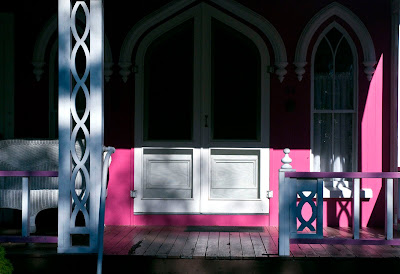
Campground Porch, 2010

Surrounding the Oak Bluffs, Massachusetts Tabernacle that I wrote about yesterday is a community of several hundred narrow cottages arranged in concentric circles and winding paths around Trinity Park. Most of them are seasonal residences that started out as tents and morphed over time into hard-sided sheds and eventually fully enclosed structures.

Many of the cottages have been in the same families for many generations. Each summer they return and figure out how to cram new generations of grandchildren and great grandchildren into the eaves.

Most of the cottages have a simple floor plan that features a living room and kitchen downstairs and a single bedroom and bath up a steep and narrow ladder stairs. Over the years, some of the cottages have been bumped up and out a little. But the campground lots are so narrow and shallow that those who want to make more personalized statements with their cottages have to make do with paint and superficial decorations.

The Pepto House, 2010

For a community originally established by fundamental Christians, it seems a little ironic that the campground has evolved into such a colorful collection of residences. I don’t know what the chaste revivalists of the 1800s would say about this. But today the brightly colored cottages are a popular tourist attraction.

The highlight of the summer season is Illumination Night, when residents turn off electric lights, hang illuminated Chinese lanterns from the rafters of their porches and join in a concert and songfest in the Tabernacle. It’s a wonderful sight that’s been going on for over a hundred years. It’s real Americana (but not of the Palin sort).

Windows Pay Respect, 2010

Despite all of the forgoing, I’ve found that a little bit of Cottage City goes a long way with me. Every time we visit Martha’s Vineyard I take a walk in the campgrounds. But I find I overdose quickly on all the cutesy curlicues and mishmash of contrasting colors. On our recent trip there I decided I needed to get past that and give the Cottage City a little more respect. I didn’t have much time, and still find that I have to take the Campground in small doses. But over time I hope I’ll give it a fair shake.

Campground Color, 2010

One of the Few "Big" Campground Houses, 2010


Tuesday, November 9, 2010

Anatomy of the Picture

Campground Tabernacle, 2010

I’ve been visiting the “cottage city” at Oak Bluffs, Massachusetts for many years. It’s a vestige of the Chautauqua movement of the late 1800s, wherein city dwellers of the Industrial Age went out into the fresh air of the countryside for a couple of weeks each summer, pitched tents and held revivals. Over time the summer tents were replaced with hard-sided sheds that over time morphed into permanent seasonal and year-round homes. (More about the cottage city tomorrow.)

At the center of the campground is a large shed-style amphitheater that seats 1,000 people and is known as the Tabernacle. Church services are held there regularly throughout the summer. Lectures and light musical entertainment take the stage in the afternoons and evenings.

Tabernacle 1, 2007

Over the years I’ve wanted to take a meaningful photograph that said something about the history and roots of the Tabernacle. But it seems like all I ever took were informational pictures, just this side of mindless documentation. On our recent trip to the Vineyard I decided to try to do a little better.

Tabernacle 3, 2017

The Tabernacle’s a challenging place to photograph in the daytime. It’s open on the sides and the contrast between the sunny exterior and the shaded interior makes for tricking exposure. On this trip I also only had about 45 minutes to make whatever photographs I was going to make there.

I walked around the Tabernacle for a while to try to get my mind attuned to the history and pace of this place. When you step into the Tabernacle it’s possible to feel that you’ve stepped back into history. There are modern conveniences, such as electricity and indoor plumbing. But one’s first impression is that this is a place that hasn’t changed much in more than a hundred years.

From time to time I would sit down and try to figure out what the right visual metaphor would be for this place. It’s easy to want to capture the grandeur of such a large space. But that’s not usually my style, and I finally realized it was the seating itself that would be my story. People attending activities at the Tabernacle sit on either simple hard wooden benches or in plain wooden chairs.

The seats alone weren’t enough, of course. But when you combined a casually dissembled row of chairs with the light cast from one of the overhead leaded glass windows, you had something.


Monday, November 8, 2010

Overheard: In The Surgery Waiting Room

Waiting, 2007

Every one a story:


“I told him you can't just cut across the top. I was right back there again. And we'd just fought off infection in the same toe. I told him you've got to cut down the sides. Thought my toe would just fall off.”


“Are you sure he’s really a doctor?”


“Cutting in a V-shape is not the right way. Hell, I could have told him that.”


“They say peroxide chases an infection in, not out.”


“He's already told me I can do things to you. You just wait and see what happens when we get home.”


“I tell you, it's all stress. All of it. I don't know why he'd have it. I keep telling him not to have it. I tell him that all the time. But do you think he listens to me?”


“Those Wendy's onions stay with you, don't they?”


“My mind's right. It's my body that's out of whack.”


“He has pain everywhere, especially you know where.”


“I told that doctor, ‘Just put a sock on it.’ That's just what I said.”


“They told me two hours. We've been here three hours already. I hope Beth appreciates how long we've been waiting.”


“If the lord wants this to be her time, that's just what it'll be. Ain't nothing we can do about it.”


“Do you see that lady's green shoes? Imagine wearing those at the hospital, what with all these sick people around.”


“Sweetie, your daddy's going to be just fine.”


“zzzzzzzzzz”


“It must run in the family.”

“I told him how to get here. If he can't find it it's his own damn fault.”


“You'd think they'd have something Christian on the TV in a hospital.”


“Do you think I really care what Jimmy thinks?”


“Her foot was stuck to the tree, I tell you. Stuck! I think she broke every single bone in it. Her foot, I’m talking about. I don't know about the tree.”


“I fell flat out on my kitchen floor.”


“That was some terrible food.”


“The force of hitting the floor of the car...”


“I can't keep up with every old fart I know.”


“I'm just fine. I wanted to ask her ‘How are YOU?’"


“My little finger is dead from all my surgeries.”


“The doctor said, ‘Who's the patient here?’ Just who does he think he is to say something like that to me?”


“Didn't you want to kill him?”


“They don't have a clue what it's like.”


“Did you hear the one about the monkey that walked into the bar?”


“The doctor told me I needed to get a hospital bed for him. I told him I'm not going to put a damned hospital bed in my dining room. I don't care how close to death he is! Not in my dining room!”


“I'm tired of waiting.”


“She walked those three steps up from the garage into my family room just like she owned the place. The gall! The next time she came she acted like nothing at all had happened.”


“I can't wait for the party we're going to have when she gets better.”


“The kind of help I want to give is not the kind of help he needs.”


“Linda thinks he made up the blindness to get sympathy. I think what he really has is ADHD.”


“The judge told the father that he had to take the child out of that environment.”


“He looks like he's listening. But he's not listening.”


“I'm so worried. I've been praying all day. But I'm not getting any answers.”


“Oh, barman! I’ll have what the grasshopper down there’s having.”


Friday, November 5, 2010

@TED

Providence Yellow, 2010

I attended the TEDxNASA conference yesterday. TED is a nonprofit organization devoted to “Ideas Worth Spreading.” If you’re not familiar with TED, you can learn about it here.

The “big” TED conferences are held just a few times a year in the U.S. and Britain and draw a blue chip audience from the realms of science and technology, entertainment, design and commerce. The price of admission is something like $6,000. The TEDx conferences, on the other hand, are local, independently-organized events that follow a standard TED format and meet certain content standards.

This was the second year for TEDxNASA, which is sponsored by the NASA Langley Research Center and the National Institute for Aerospace. Just under half of the members of the audience of some 1,600 people were, indeed, rocket scientists and aerospace engineers. Among the presenters this year were business thinkers, social scientists, writers, artists, designers, musicians, a poet, health experts, apps developers, rocket scientists and others. They were a lively parade of idea people.

More than a few of them, though, were what I would describe as “motivational” speakers, a category that usually doesn’t appeal to me. But as I looked back last night at my notes from the day I had to admit that some of their advice spoke to me even though I’d heard it many times before.

For example, Andy Stefanovich, of the innovation consulting firm Prophet, shared these suggestions:

  • Create breathing space to work on your projects.
  • Create excuses to have experiences.

I think I’m pretty good about the breathing space part. But when Stefanovich starting talking about creating excuses to have experiences, I realized I’d hadn’t been doing that lately. One of the benefits of being self-employed is that I should be able to make time to work on photography now and then during the workweek. There are times, of course, when the “day job” requires five (or six or seven) full days of work in a week. But many weeks that isn’t the case.

Experiences are the lifeblood of many artistic endeavors, and that certainly includes photography. A few summers ago I was able to arrange my work schedule so that most weeks I could take Fridays off from the “day job” to pursue photography.

I haven’t done that in a long time, though. And although I haven’t’ been without photographic subjects or projects to work on, I’m going to have to get better about creating excuses to have experiences.

How do you do it?

The pictures in this post were taken when I had a few hours free during a recent business trip to Providence, Rhode Island.

On Reading, 2010


Coupla Chicks Talking Trash on Thayer Street, 2010


Thursday, November 4, 2010

Reflections

Cottage Street Reflection, 2010

Don’t worry. I’m not going to get all sentimental on you. In fact, this will be kind of short.

It’s about reflections, the kind you see when you look at one thing that has a shiny surface and see in it the reflection of something that’s behind you.

Looking through my pictures, I have a lot of photographs of reflections. One of my favorites is a picture taken years ago in New York. It’s the window of a shop located in the Sherry Netherland Hotel on Fifth Avenue. All the action in the picture, made jittery by the reflection, sums up the hustle bustle life of New York for me.

A La Vieille Russie, 2003

For years, it seems, I considered only those reflections that were more or less at eye level. I have various pictures of myself taken in reflections, like this and this and this.

In recent years, though, I’ve learned to look down more for reflections, especially after it rains. Since I don’t take a lot of pictures in the rain, they’re the next best thing, and a lot of fun.

Fuller Street Reflection, 2003


Winter Amusement, 2004

Wednesday, November 3, 2010

The First Shot

California Sun, 2010

The first shot of the day can be easy. It can be hard. Whatever the case, it’s the one you have to take, to get through, before you can get on to serious business.

For me, the first shot of the day is usually ceremonial, a shot just to start up the muscle memory, the signal to my body that I’m ready to start taking pictures. Once I take it, the other pictures start flowing.

The other day in LA, my first shots were taken in my hotel room. I started by looking out the window, an admittedly dubious thing when the thing that takes up most of the view is a solid wall. I’d had a good laugh over this view when I checked in the day before. Here I was in the California, where the light and colors are straight out of a Hockney painting, and my room faced a wall!

Anyway, here was the first shot, the muscle memory trigger.

Strata, 2010

That first one sure wasn’t anything to write home about. But by getting a little closer to the window I discovered a slightly more interesting shot, California Sun, above.

Our Flickr friend Christine’s pictures of hotel rooms are so interesting, so fill of story potential, that whenever I see a scene of sheets tussled, of the morning after, they’re what I think of. My third shot of the day was this homage to Christine.

The Morning After, 2010